Cybersecurity as a Quality Issue: The Intersection of ISO 27001 and ISO 9001
In today’s digital environment, cybersecurity is no longer just an IT concern — it is a core quality issue.
Organizations are increasingly recognizing that protecting information, systems, and data integrity directly impacts product quality, customer satisfaction, and operational reliability.
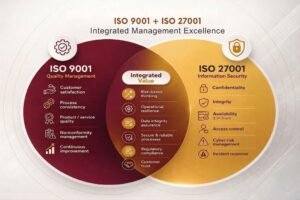
This is where ISO 27001 (Information Security Management System) and ISO 9001 (Quality Management System) intersect.
Understanding this relationship allows organizations to build a resilient, integrated management system that strengthens both quality and security performance.
Why Cybersecurity is a Quality Issue
Quality is defined by the ability to consistently meet customer and regulatory requirements.
Today, those requirements include:
- Protection of customer data
- System availability and reliability
- Data integrity and accuracy
- Secure digital processes
A cybersecurity failure can lead to:
- Service disruption
- Loss of customer trust
- Regulatory non-compliance
- Financial and reputational damage
From a quality perspective, these are nonconformities.
ISO 9001 and Cybersecurity: Where It Fits
ISO 9001 does not explicitly mention cybersecurity, but its framework inherently supports it.
Key clauses include:
Clause 4 – Context of the Organization
Organizations must identify internal and external issues — including cyber risks.
Clause 6 – Risk-Based Thinking
Cyber threats are critical business risks that must be identified, evaluated, and mitigated.
Clause 7 – Support
Includes competence, awareness, and infrastructure — all relevant to secure systems.
Clause 8 – Operational Control
Secure handling of data and processes is essential for consistent service delivery.
Clause 9 – Performance Evaluation
Monitoring incidents, breaches, and system reliability supports quality objectives.
Clause 10 – Improvement
Cyber incidents trigger corrective actions and continual improvement.
ISO 27001: Structured Cybersecurity Management
ISO 27001 provides a formal framework to manage:
- Information security risks
- Access controls
- Data protection
- Incident response
- Business continuity
It complements ISO 9001 by adding structured security controls to protect process integrity.
The Intersection: Where ISO 9001 Meets ISO 27001
Organizations benefit most when both standards are integrated.
🔷 Shared Principles
- Risk-based thinking
- Process approach
- Leadership involvement
- Continual improvement
- Documented information control