In many organizations, risk management still enters the conversation too late.
After strategies are approved.
After delivery models are locked.
After capital is committed.
At that point, risk functions are asked to “review,” “sign off,” or “ensure compliance.” While necessary, this approach limits impact. Compliance can confirm adherence to rules, but it cannot prevent strategic exposure that has already been embedded into decisions.
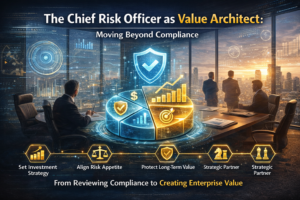
This is why leading organizations are redefining the role of the Chief Risk Officer (CRO). Not as a supervisory gatekeeper, but as a value architect—a senior executive who aligns risk appetite with growth, investment decisions, and long-term resilience.
The difference between these two models is not semantic. It directly affects performance, predictability, and decision confidence.
The Structural Limitation of Traditional Risk Functions
Most governance, risk, and compliance (GRC) functions are positioned downstream of decision-making. They review what has already been decided rather than shaping what should be decided.
This creates three persistent weaknesses.
Risk Becomes a Constraint, Not an Input
When risk is introduced after strategy formation, it is perceived as friction. Findings are negotiated, softened, or deprioritized to protect momentum. The organization remains compliant—but strategically exposed.
Scenario Analysis Loses Its Power
Without senior mandate, scenario-based analysis and stress testing are often treated as formalities. They exist on paper but fail to influence investment timing, delivery strategy, or contingency planning.
In EPCM, infrastructure, data centers, and energy projects, this gap is costly. Projects rarely fail due to unknown risks; they fail because known risks were not integrated early enough.
Risk Appetite Remains Implicit
Many organizations operate without a clearly articulated risk appetite. Decisions are driven by precedent, urgency, or commercial pressure rather than a deliberate understanding of acceptable exposure.
When risk appetite is implicit, alignment is accidental. When it is explicit, alignment becomes a governance asset.
Reframing the CRO as a Value Architect
To move beyond compliance, the CRO role must evolve from oversight to architecture.
A value-architect CRO does not ask only, “Is this compliant?”
They ask, “Is this decision aligned with our risk appetite, strategic objectives, and capacity to absorb downside?”
This reframing shifts risk from control to contribution.
From Supervisor to Strategic Partner
A CRO operating as a value architect sits alongside the CFO, COO, and CEO—not beneath them. Their mandate extends to shaping:
- Capital allocation and portfolio risk
- Contracting and risk transfer strategies
- Delivery models and governance thresholds
- Risk-adjusted performance expectations
This requires a formal seat at the table, not ad hoc consultation.
From Risk Registers to Decision Confidence
Traditional risk artifacts—registers, heat maps, dashboards—have limited value unless they inform decisions.
Executives need clarity, not volume:
- Where are we overexposed relative to return?
- Which risks threaten strategic objectives, not just project KPIs?
- What trade-offs are we consciously accepting?
This is where risk management begins to create enterprise value.
Why Senior Mandate Is Essential
Even highly capable risk teams underperform without executive authority.
The Cost of a Missing Voice of Risk
When the CRO lacks senior mandate:
- Scenario analysis is diluted
- Escalations are delayed or softened
- Stress testing avoids uncomfortable outcomes
In regulated and capital-intensive environments, this often results in:
- Schedule collapse despite apparent compliance
- Cost overruns driven by unchecked assumptions
- Regulatory scrutiny after issues become visible
These are failures of governance—not failures of compliance.
Authority Enables Risk Excellence
Risk excellence is not driven by better tools alone. It requires authority to influence decisions before commitments are made. This aligns with management system principles emphasized by the International Organization for Standardization, where leadership accountability and risk-based thinking are core expectations—not optional enhancements.
Aligning Risk Appetite With Growth
One of the CRO’s most critical responsibilities is translating risk appetite into operational reality.
Risk Appetite as a Strategic Enabler
When clearly defined, risk appetite accelerates decision-making. It provides clarity on:
- Which risks are acceptable in pursuit of growth
- Which risks require mitigation before proceeding
- Which risks are fundamentally misaligned with strategy
Without this clarity, organizations default to inconsistent, personality-driven decisions.
Embedding Risk Appetite Into Delivery
In EPCM and regulated industries, this alignment should be visible in:
- Contract structures and risk allocation
- Contingency thresholds and escalation triggers
- Assurance depth and frequency
- Investment stage-gates and approvals
When risk appetite is operationalized, quality assurance shifts from inspection toward decision assurance.
Quality Assurance Beyond Compliance
Quality and risk functions are often separated structurally, but they are inseparable strategically.
Quality assurance focused only on conformance verifies outcomes after the fact. Quality assurance aligned with enterprise risk protects value before it is lost.
When integrated:
- Nonconformities become early indicators, not post-mortems
- Findings are assessed for business impact, not just deviation
- Assurance effort is concentrated where exposure is highest
In complex, regulated environments, this integration is essential for resilience.
Conclusion: Risk as a Source of Advantage
Risk management was never meant to be a policing function. At its best, it is a strategic discipline that enables confident growth under uncertainty.
Repositioning the Chief Risk Officer as a value architect is not an organizational tweak—it is a leadership decision. One that signals maturity, accountability, and foresight.
For organizations operating in EPCM, infrastructure, data centers, energy, and regulated sectors, the question is no longer whether risk deserves a seat at the table. The question is whether decisions made without a credible voice of risk are sustainable.
Partnering With JAGS Assurance
JAGS Assurance supports organizations in strengthening governance, integrating risk with quality assurance, and designing risk-based assurance frameworks that move beyond compliance toward confident, resilient decision-making.